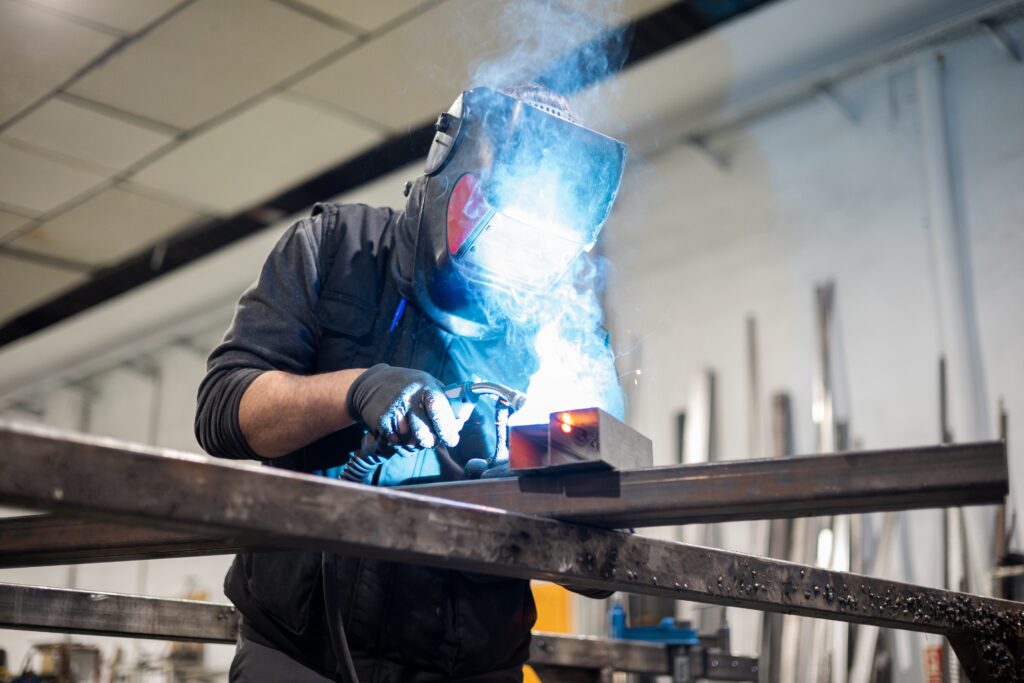
In industrial fabrication, welding methods are chosen based on what the job actually requires. Material type, joint design, fit-up, service conditions, and whether the work happens in the shop or in the field all influence which process makes the most sense.
That is why there is no one welding method for every application. The right process helps support strength, consistency, and overall fabrication quality from the start.
MIG Welding for Production Work
MIG welding is often used when a job requires efficient production and consistent weld quality across a wide range of fabricated parts. It is commonly applied to structural components, frames, supports, guards, and other assemblies where repeatable results matter throughout the build.
For many industrial applications, MIG welding offers a reliable process for keeping work moving through the shop while maintaining quality standards.
TIG Welding for Precision and Finish
TIG welding is typically used when the work calls for more control. It is often a better fit for thinner materials, more detailed assemblies, or parts where weld appearance and precision carry more weight.
It is especially useful when the application requires:
- controlled heat input
- cleaner weld appearance
- more precise weld placement
- tighter work on lighter-gauge material
When fit and finish are part of the priority, TIG usually gives the fabricator more control over the final result.
Stick Welding Still Has a Place
Not every welding job happens under controlled shop conditions. Some applications demand a process that can handle heavier work or less forgiving environments, and that is where stick welding still makes sense.
Its value is often tied to practicality. For certain repair work, field applications, or tougher conditions, stick welding remains a reliable option because it is durable, adaptable, and well suited for work that does not always happen in ideal circumstances.
The Process Should Follow the Application
The strongest fabrication work usually starts with choosing the process that fits the application, not the other way around. Different welding methods solve different problems, and the right choice depends on the job in front of the team.
A few of the factors that usually shape that decision are material, thickness, joint design, required strength, and where the work is being performed. When those decisions are made well early, the rest of the fabrication process tends to move more cleanly.
Good Welding Depends on More Than Technique
Even the right welding method can fall short if the surrounding work is not handled properly. Weld quality is also shaped by fit-up, preparation, material knowledge, and consistency from one part of the job to the next.
That is part of why welding should be viewed as one part of the larger fabrication process, not as a standalone step at the end. The better the prep and coordination around it, the stronger the finished assembly tends to be.
Built for Industrial Demands
Each of these common welding methods serves a different role in industrial fabrication. MIG supports efficient production, TIG gives more control, and stick remains valuable in demanding conditions. The goal is not to force every job into the same process, but to use the method that best supports the strength, fit, and performance the work requires.
For industrial teams that need fabrication built around real project demands, JAG Professional Services provides MIG, TIG, and stick welding as part of its broader custom metal fabrication capabilities.
Need welding support for an industrial project? Request a quote or schedule a consultation to discuss your material, assembly, and fabrication requirements.